


Death and Taxes

They say there are only two things certain in life…

I’m not anti-tax. I believe we should all pay our fair share. The issue being what’s considered fair. Should the very wealthy get the biggest tax breaks? Should the very poor pay no tax? Should the heaviest burden be placed on the middle class? If you follow politics you will get a good sense of how these questions divide us politically and socially.

One of the biggest drains on retirement income, besides the unpredictability of medical costs, is taxes. If you can maintain a low cost lifestyle in retirement, you can live off your retirement accounts nearly tax free.

There are three types of investment accounts; taxable accounts, tax deferred accounts and tax exempt accounts.

Taxable Accounts

Taxable accounts include brokerage accounts which are also known as individual taxable accounts. These are funded by after tax dollars and there is no limit on your contributions. Since you have already paid taxes on these dollars, you are not required to pay any additional tax on your distributions. However, you must pay taxes on any gains you made on these dollars known as capital gains. There are two types of capital gains and are taxed differently. Any gains you realize on distributions which are less than twelve months old are considered short-term capital gains and are taxed at a higher rate, as high as 37%. Any gains disbursed after twelve months are considered long-term capital gains and are taxed at your standard income tax rate. You will also be taxed on dividends. Dividends are generally taxed on an annual basis at your standard tax rate for taxable accounts, and would not incur additional taxes at the time of disbursment.

Tax Deferred Accounts

Tax deferred accounts, a type of tax advantaged account, are funded by pre-tax dollars. These include accounts such as your workplace 401k or standard IRA. Since you do not pay taxes on your initial investments, gains or dividends until you start to take disbursment, there is a limit on annual contributions. These limits are currently set at $19,000 or $25,000 for 401k if you are over 50, and $6,000 for IRA’s or $7,000 if over 50. The requirements on when you can begin your disbursments without additional tax penalties is currently set at age 59 1/2, at which time your disbursments would be taxed at your standard tax rate. It’s also important to note, if you are separated from your current employer at age 55, you may also be eligible for penalty free withdrawals from their sponsored 401k. If you roll these dollars over to an IRA, you are not eligible to withdrawal at age 55 without an additional tax penalty.

Tax Exempt Accounts

Tax exempt accounts are also a type of tax advantaged account and are funded with pre-tax dollars. These accounts include your Roth accounts and grow truly tax free. You may withdrawal your contributions at any time, but since you pay no tax on disbursements, including gains after age 59 1/2, there are limits on contributions. Contribution dollar limits are set the same as your standard IRA and your total IRA contributions cannot exceed these limits annually. There is also a limit on who is eligible based on annual household income. Since these limits can change from year to year, I encourage you to check these limits each tax year. A big advantage to the Roth for early retirees, is the ability to rollover funds from your tax deferred accounts to your Roth account penalty free, as long as you wait 5 years to dispurse these dollars. This is known as a Roth Ladder.

Disclaimer: I am not a licensed financial planner or tax expert. Any views expressed are my own and based on what I have learned on my financial journey. Please do your own research before making important financial decisions.

The Roth IRA and Roth Ladder

Maybe the most powerful tool in the retirement toolbox is the Roth IRA. That said, there are a couple of drawbacks we will discuss first to get them out of the way.

1. There is an income limit for the Roth IRA. The limits can change year to year so I advise you to check these limits before opening your IRA.

2. There is a maximum annual contribution for the Roth IRA. Again, these limits can also change year to year so best to know the rules. If you open an IRA and break the rules, you can face stiff financial penalties.

Now, for the good stuff…

The Roth IRA is funded with after tax dollars. This allows the IRA to grow truly tax free as opposed to a traditional IRA or 401k, which is funded with pre-tax dollars, and are considered tax deferred accounts. When you withdraw funds from the tax deferred accounts, you must pay taxes on your contributions and possibly your gains, especially if you are planning to retire before age 59.5.

During early retirement, chances are you will have the bulk of your monetary assets in your 401k. If you withdraw these funds before age 59.5, you are taxed at your current tax rate, plus an additional 10% penalty. To avoid this penalty, you have a couple of options. If you are 55, and separate from the company sponsoring your 401k, you can begin early withdrawal without penalty. If you are not yet 55, or maybe have multiple 401k accounts from previous employers, you can do what is called a Roth Ladder.

In order to build your ladder, you will first need to have a good understanding of how much you need per year in retirement. I advise you to track your spending for several years before retirement to understand your spending needs. This is also a good way to reduce your spending habits by understanding where your hard earned money is being spent on a monthly and yearly basis.

After you have a good handle on your annual finances using Personal Capital, You can calculate your future needs including inflation and taxes. I have included a link to my favorite spreadsheet here. If you are anything like me, this will give you hours of enjoyment running through “what if” scenarios. This spreadsheet will help you build a plan for your Roth Ladder as well.

The basis of the Roth Ladder is a sort of loop hole in the tax rules. Basically, you can transfer assets from your deferred accounts into your Roth account, before your official retirement age of 59.5, and not have to pay the 10% penalty. The catch is, you can’t touch the funds for 5 years. There is no max limit on how much you can transfer, unlike the contribution limits I explained earlier. During this 5 year period your contributions and transfers will continue to gain value with your investments.

To better explain the Roth Ladder, let’s say Joe retires at age 52 with the following assets:

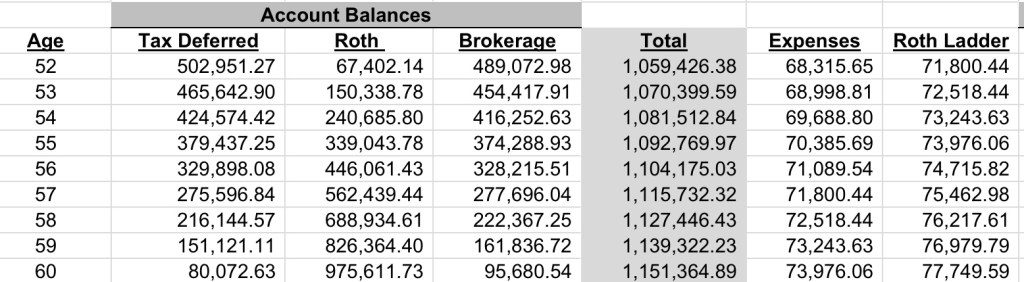
Joe has calculated his annual expenses in the first year of retirement, and is using an 8% rate of return with a 4% withdrawal rate from his retirement accounts. Using the retirement spreadsheet, adjusting for annual increases and reduced spending to help offset some of the inflation costs, Joe comes up with the following personalized Roth Ladder.

The good news for Joe is that by controlling his spending, and having a little luck with the markets, he will be able to maintain his lifestyle and increase his wealth or increase his annual spending, should he choose to.

The bad news, remember when I said you can’t touch your Roth conversions for at least 5 years? Well, Joe will have to fund at least his first 5 years of retirement before he can tap into his Roth account. Also, you can’t change your mind after you have started the transfer. The best advise is to wait until late in the year to analyze your spending before beginning your annual conversion.

More good news for Joe, he has built up a significant brokerage account which can sustain him for the first 9 years of his retirement. Here is what Joe’s ladder looks like through age 78.

Keep in mind that your conversions are taxed as income at your current tax rate. If you want to start your conversions before you retire, you will need to calculate in this additional income for tax purposes, along with your salary. Obviously this is not a popular choice for most early retirees.

There is also an option to stretch out your conversions over a longer period of time to reduce your taxable income. For this option, it may be best to complete your conversions before age 70 when the mandatory withdrawals kick in for tax deferred accounts. The spreadsheet can assist with this scenario. Feel free to run the options and see what works best for you. Here is what Joe’s ladder looks like by spreading his conversions before age 70:

Disclaimer: I am not a licensed financial planner or tax expert. Any views expressed are my own and based on what I have learned on my financial journey. Please do your own research before making important financial decisions.
How Much Money Do I Need to Retire?

How much is enough? This is a great question and a lot of folks smarter than me have tried to do the math. Most people in the FIRE community use the rule of 25 or 33, depending on how early you plan to retire. This rule states that you should take your expenses and multiply that number by 25 to figure out what your financial independence number should be. So if your annual expenses are $50k per year, 50000×25=1,250,000. Now, don’t get me wrong, this is a lot of money. But consider what this number will look like with taxes and a 2-3% inflation rate over 25 years. Nobody knows exactly what the future holds so we must rely on data from the past.

The next formula you should be aware of is the 4% rule. This rule states that if you use the rule of 25 to achieve your FI number, you can safely withdrawal 4% of your retirement savings and never run out of money. This rule is also referred to as the Trinity Study in the personal finance and FIRE community.

Now I am going to go out on a limb here, so bare with me, and keep in mind that these are just my opinions. Please research on your own and draw your own conclusions.

The rule of 25 is a great target, but can I retire on less? That was a rhetorical question, but feel free to ask yourself the same. Personally, I feel pretty confident that I have kept my lifestyle such that I could, but each person needs to evaluate their own situation. With respect to the 4% rule, I feel like this is a bit conservative, but may be designed that way to insure success. Based on the market conditions of recent years and inflation rates, my personal opinion is the safe drawdown rate is somewhere between 5-7%. I look forward to testing this theory out someday myself. As I stated before, do your own research and draw your own conclusions.

Disclaimer: I am not a licensed financial planner or tax expert. Any views expressed are my own and based on what I have learned on my financial journey. Please do your own research before making important financial decisions.

How Should I Invest

As I stated in a previous blog post, I don’t have the risk tolerance or patience to invest in individual stocks. I have a handful of stocks in an old rollover IRA, but I do not actively trade them. They were all bought when the market was at a low, around 2009, and I have just held them. The majority of my investments are in 401k or my Betterment account. You may be wondering why I chose Betterment? I evaluated several investment platforms and found the simplicity and features of Betterment to be more to my liking. For those of you who may not be familiar with Betterment, it is a Robo-advisor platform. For people like me, who don’t want to spend hours and hours evaluating and tracking investments, Betterment asks you a few questions and then selects the best investment portfolio for you. It also has tax loss harvesting tools built in which will select the best options when you start your withdrawal process or need to sell for tax purposes.

Betterment uses a mixture of stocks and bonds to help flatten out the bumps when the market is volatile. Based on your years till retirement and risk tolerance it will advise you on the right mix for your situation. It will also auto adjust your mix as you get closer to retirement. Since I have the majority of my retirement savings in 401k, and use my Betterment account for early retirement savings, my risk tolerance is a little higher on this platform. I maintain a 90/10 split between stocks and bonds with no auto adjustment. I may change my tune if market conditions change. Betterment does a good job of allocating my investment into multiple Exchange Traded Funds (ETF’s). These ETF’s allow you to invest in multiple companies with a single stock purchase. Betterment also reinvests my dividends and takes care of rebalancing my portfolio.

Disclaimer: I am not a licensed financial planner or tax expert. Any views expressed are my own and based on what I have learned on my financial journey. Please do your own research before making important financial decisions.

Should I Gamble My Hard Earned Money in the Stock Market?

Chances are that you will not reach financial independence, early retirement, or any retirement without investing. Of course there are always exceptions to this like winning the lottery, owning multiple rental properties, being an entrepreneur, inheritance, etc. None of these apply to me. So in my case, the best option is to invest. Now, I’m not a day trader and don’t have the risk tolerance for picking individual stocks. I believe in the tried and true method of buy and hold. The downside to this strategy is it takes time, so start now.

In an earlier post I recommended saving in your companies 401k. Even if you hadn’t yet paid off your high interest debt. The reason for this recommendation is based on 2 things. If you aren’t taking advantage of your company match you are leaving money on the table. The second reason is time. There is a well known equation called the rule of 72. Basically, divide 72 by your rate of return and that will tell you how long in years, it will take for your money to double. So, for this example, let’s say your average rate of return is 10%. Your investment will double in 7.2 years.

At this point, if you have eliminated your high interest debt, and have built up your safety net, I recommend you re-evaluate your 401k contribution. Make sure you are at least getting the full company match. Most companies will match up to 6% so check with yours to verify.

The experts will tell you to get the match in your 401k and then start investing in an IRA. There are multiple IRA choices out there so I recommend you do your research. The 2 most popular IRA’s are Traditional and Roth. A traditional IRA is funded with pre-tax dollars, like your 401k, your investments will grow tax free. Depending on your tax situation at retirement, you will have to pay taxes on your distributions. A Roth IRA is funded with after tax dollars and also grows tax free. With a Roth IRA, depending on your tax situation at retirement, you may only have to pay tax on your capital gains (the money you made from your investments). Again, I am not a tax expert so I recommend you either hire one or do your homework.

For my personal situation, I have an excellent company match and I am very close to maxing out my 401k. For 2020 the max contribution is $19,500. If you are age 50 or older, there is an additional catch up contribution eligibility of $6,500. I’m not quite there yet but getting closer every year!

Since I want to retire early, I try to invest any extra money after all the bills are paid, into my Betterment taxable account. Again, I can access this money at any time as long as I don’t withdrawal the gains. Since we live within our paycheck, I use my year end bonus to max out my Roth IRA and put the rest in my taxable account. For year 2020, the max IRA contribution is $6,000 or $7,000 if you are 50 or older. There are several rules around IRA contributions, so I advise you to research this topic further before starting your IRA.

Disclaimer: I am not a licensed financial planner or tax expert. Any views expressed are my own and based on what I have learned on my financial journey. Please do your own research before making important financial decisions.

I’ve Paid Off My High Interest Debt…Now What?

Great! So, no more credit card debt or high interest loans? Don’t cut up those cards just yet. If you have taken my advise from the previous blog post, and are using Personal Capital to track your spending, you should be seeing cash positive numbers. But what do you do with this sudden windfall of cash? Well, you have a few options. First, since you have spent all your extra money on paying off debt, there is a good chance that your safety net needs some attention. While your savings account is a great place to store money for easy access, most savings accounts have such low interest rates that your money is not working for you. It’s time to put your money to work.

Most financial experts recommend 3-6 months of living expenses in an easily accessible savings account. I keep 2 months of expenses in a high interest savings, at just below 2%, for my wife’s peace of mind mostly. The rest is invested in a Betterment taxable investment account. In the event of an emergency. I can withdrawal these funds tax free as long as I don’t touch the gains. It may take a few days to sell my positions and transfer the money, so this is not what I would consider a fluid account. Remember earlier when I said, don’t cut up the cards just yet? I have a high available balance and can use my credit card to pay for an emergency, then pay the balance from my Betterment funds transfer. Betterment also has a Safety Net account which might be more appealing to you.

Make sure you are tracking your spending and following your budget at this point. It can be very easy to take your extra cash and go blow it on something shiny. Keep thinking needs vs wants. Now, that said, don’t cut off your nose to spite your face. You deserve to treat yourself. That doesn’t necessarily mean to run right out and buy a new car. Figure out what makes you happy, without running up more debt. For me, it’s taking a day off and mindlessly vegetating in front of the television, or taking my wife out for a nice lunch. Find a balance and enjoy the successes of your hard work!

Disclaimer: I am not a licensed financial planner or tax expert. Any views expressed are my own and based on what I have learned on my financial journey. Please do your own research before making important financial decisions.

Get Out of High Interest Debt

One of the first steps to financial independence is freedom from high interest debt. Notice I didn’t say freedom from debt. Contrary to what some say, debt is not all bad. For example, I have a low interest 15 year fixed conventional mortgage on my primary residence. There are plenty of other sites out there with detailed analysis on paying off the mortgage vs investing. For sake of argument, using simple math, pouring everything into a 4 percent mortgage to pay it off early, will not net you the financial gains of taking those extra dollars to pay off high interest credit cards and loans or investing in a balanced portfolio. We will discuss this in more detail in a future blog post.

Credit cards are also not the enemy. Don’t overspend and pay off the balance each month. If you are like me, and occasionally use shopping as therapy, maybe leave the credit cards at home that day. Without some debt, your credit score may suffer. I also find using cash is difficult to keep track of my spending. Since all credit and debit transaction are electronic, it’s much easier for me to track and budget.

So, the $1million question, how do I get out of high interest debt? There is no secret pill or fairy dust. You could win the lotto, but the odds are against you. That doesn’t stop me from playing for fun when I have a couple extra buck in my pocket. 🙂 If you are struggling to pay your bills, I wouldn’t advise the lotto!

The hard truth is, you have to evaluate your spending and make some hard choices. I highly recommend using the Personal Capital App to track your spending. How much are you spending on needs vs wants? Where can you trim the budget? Can you make smarter spending choices? Depending on the severity of your situation, this could be as simple as cutting off the expensive satellite subscription, which I did, to as complicated as selling your house and renting or downsizing.

For my debt situation, I reduced my monthly expenses, consolidated my high interest debt into a lower interest line of credit from my bank and changed jobs for a higher income. If changing jobs isn’t an option for you, consider a side hustle. There are plenty of websites out there with examples of side hustles and one may work for you!

I am fortunate enough to get an annual bonus. We don’t count these dollars as part of my salary, so we don’t rely on the bonus for expenses. The first 2 annual bonuses went straight to paying down the high interest debt. For us, we used the snowball method. We paid off the lower balances first and used the extra monthly savings to pay extra on the larger debt. Financially it makes more sense to pay off the higher interest debt first, but psychologically, the snowball worked better for us and helped to keep us motivated. Moral of the story, do what works best for you, but do something. Don’t wait or hesitate. Start today!

Disclaimer: I am not a licensed financial planner or tax expert. Any views expressed are my own and based on what I have learned on my financial journey. Please do your own research before making important financial decisions.

The Financial Freedom Journey Begins

I was raised an Air Force brat and spent my youth moving from public school to public school, never making friends for too long. Back in those days there was no social media or Internet, so long distance friendships weren’t really a thing.

I wasn’t very good in school, so when graduation day came around, while most of my friends were planning their university move in day, military career, or joining the family business, I was relocating once again with my family from Florida to Arkansas.

My father was career military and raised his family of 5 on an enlisted airman’s paycheck. He lived the same cycle of debt most military families experience, which feels like just above the poverty line.

My parents always bought us what we wanted, whether they could afford it or not. big Christmases, big birthdays, Boy Scouts, sports, it all went on the credit card. When I started working, my fathers advise was to save 10% of my income in savings. Of course that advise never stuck and I continued the same cycle of high interest credit and frivolous spending.

When my wife and I started our family, we already had a decent amount of credit card debt and had been upside down on fancy cars we couldn’t afford. We were renting a 2 bedroom duplex, had 2 Schnauzers, dual income, no savings and bought pretty much whatever we wanted. When suddenly, one day my wife announced to me that we were having twins. After I picked myself up off the floor, the fancy sports car was quickly traded for a 4 door sedan and we were all set with our family of 4, one boy, one girl, one income. We were settling into our crazy life of double bottles, diapers, strollers and no sleep. Not quite done yet though…two months later…pregnant again. The 4 door sedan was soon replaced with the mini van and the 3rd car seat was added for our youngest daughter. I like to jokingly say that I finally figured out what was causing this condition and put a stop to that funny business!

I was working a factory job with good health insurance but barely making ends meet. I’m not too proud to say that we were on WIC and thankful for family who helped us as much as they could. 401k and savings were the furthest from our minds, but that didn’t stop us from running up the credit card. I can remember driving an hour to Memphis to buy my first Packard Bell computer and charging it to the Sears card at what was probably 18% interest while making minimum payments. I can’t even begin to imagine how much that computer actually cost me with interest.

At some point I did move into IT as a Desktop Technician and saw a small salary bump. I began contributing 2% to my 401k plan, probably because, if I didn’t, my company was going to force me to contribute 5% through auto-enrollment. Of course I could never afford that much, right?

When I left that job I made one of the deadly sins of personal finance, and cashed out the 401k. NEVER DO THIS! Not only did I end up paying the income tax, but there was also an additional tax for early withdrawal which reduced my year end tax return significantly.

So, long story short kids, invest in your company 401k and do your best to get the full company match if they offer one. These are before tax dollars and you will not miss the money, as much as you might think. NEVER cash out your 401k. If you change jobs, you can rollover those funds to your new 401k or to a traditional rollover IRA. If your 401k provider doesn’t support direct rollovers, you are allowed 1 cash rollover in a 12 month period. You must deposit those funds into your new retirement account within 60 days or face the dreaded early withdrawal penalty.

Disclaimer: I am not a licensed financial planner or tax expert. Any views expressed are my own and based on what I have learned on my financial journey. Please do your own research before making important financial decisions.